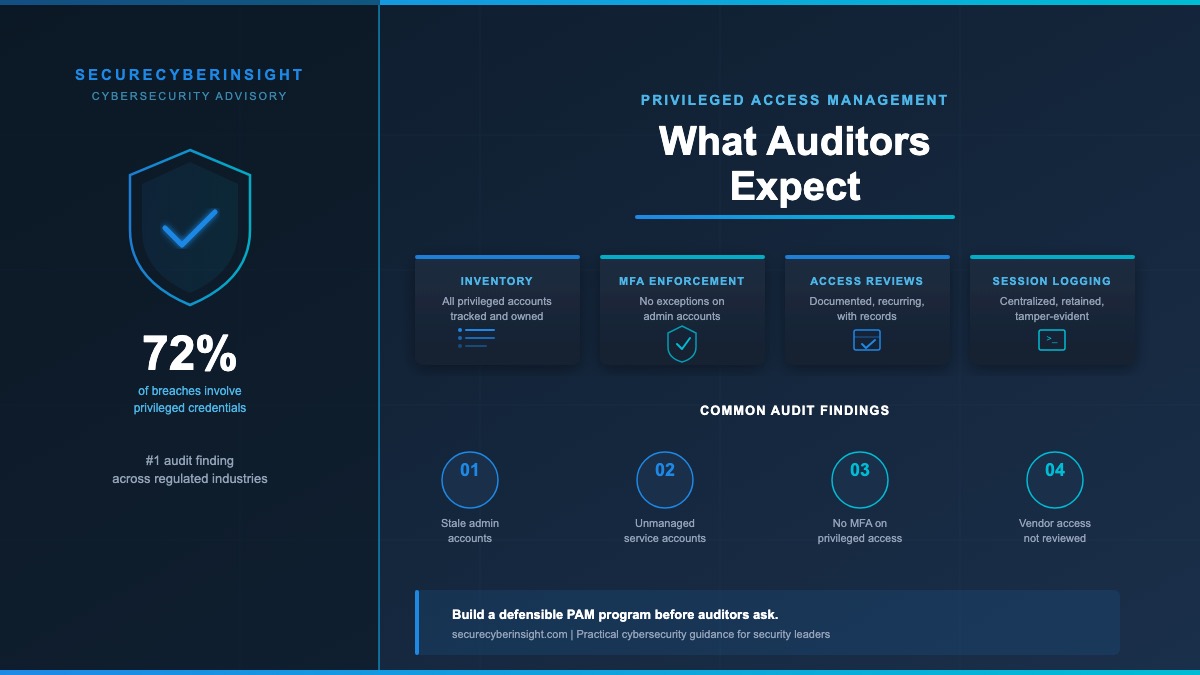
Bottom line: Privileged access management audit success comes down to four things: knowing what you have, controlling who can use it, reviewing it regularly, and documenting how the program works. Organizations that can demonstrate those four things consistently encounter far fewer PAM-related findings.
Privileged access management consistently ranks among the top findings in cybersecurity audits across industries. The pattern is predictable: auditors arrive, request a list of users with administrative or elevated access, and find accounts that are excessive, unreviewed, shared, or entirely untracked.
Understanding what auditors actually look for — and why — is the fastest path to closing the gaps before they become formal findings.
What privileged access actually means
Privileged access refers to any level of system, application, or data access that exceeds what a standard user account requires. This includes:
- Local and domain administrator accounts on servers and workstations
- Root access on Linux and Unix systems
- Database administrator and service account credentials
- Cloud infrastructure roles with the ability to create, modify, or delete resources
- Application accounts with access to sensitive data or the ability to change configurations
- Network device management access
The common thread is impact. If a privileged account is compromised, misconfigured, or misused, the potential damage is significantly higher than with a standard user account. That is why auditors pay close attention.
Why privileged access is a top audit target
Privileged accounts are one of the primary attack paths threat actors use to move laterally through an environment after an initial breach. Credential theft, pass-the-hash attacks, and exploitation of poorly managed service accounts are well-documented techniques for escalating access from a limited foothold to full domain or cloud environment control.
Regulatory frameworks including NIST SP 800-53, CIS Controls, CMMC, SOC 2, and FFIEC IT Examination Handbook requirements all address privileged access management explicitly. When auditors review cybersecurity programs, they are evaluating whether the organization has implemented controls proportionate to the risk these accounts represent.
The answer is frequently: not quite.
What auditors actually look for
An accurate inventory of privileged accounts
Auditors typically start by requesting a complete list of accounts with elevated access. They compare it against what they can observe or what the organization's own systems report.
Gaps between the two are almost always present. Dormant administrator accounts from former employees, local administrator accounts that were never tracked centrally, shared service credentials in scripts and configuration files — these are common discoveries.
A defensible program starts with knowing what exists. Without a maintained inventory, every other control becomes harder to validate.
Least privilege enforcement
Least privilege means accounts have only the access necessary for their specific function. In practice, it means:
- Standard users do not have local administrator rights unless there is a documented, approved reason
- IT staff use separate privileged accounts for administrative tasks rather than their standard accounts
- Administrative access is scoped to specific systems or environments rather than granted broadly
Auditors look for evidence that least privilege is a design principle, not just a policy statement. The evidence is in the actual access controls, not the written policy.
Multi-factor authentication on all privileged access
MFA on privileged accounts is now a baseline expectation in nearly every audit framework. Finding privileged access — especially remote privileged access — protected only by a username and password is an immediate finding.
This applies to:
- Remote desktop and SSH access to servers
- VPN connections used for administrative purposes
- Cloud console and API access for roles with elevated permissions
- Jump host and privileged access workstation authentication
There is no longer a meaningful audit or compliance argument for not having MFA on privileged accounts.
Session monitoring and logging
Auditors want evidence that privileged account activity is logged and that those logs are retained, protected from tampering, and reviewed. At minimum, this means:
- Authentication events for privileged accounts captured in a central logging system
- Sufficient log retention to support forensic investigation (typically 90 days minimum, with 12 months for many regulatory frameworks)
- Alerts or review processes for anomalous privileged activity
Privileged access management tools that record sessions provide stronger evidence than basic logs alone, but centralized logging of authentication events is the baseline expectation.
Periodic access reviews
Administrative access should be reviewed at defined intervals — typically quarterly for the highest-risk accounts and at least annually for others. Reviews should document:
- Who reviewed access and when
- What access was confirmed as appropriate
- What access was removed and why
Auditors ask for the records. Organizations that can produce them with clear ownership and follow-through demonstrate a functioning control. Organizations that cannot are typically issued a finding regardless of what the access actually looks like in the system.
Service accounts and shared credentials
Service accounts represent one of the most consistently problematic areas in privileged access audits. The common issues:
- Service accounts with interactive login capability and no clear owner
- Credentials that have not been rotated in years
- Shared passwords used across multiple systems or services
- Service accounts with broader privileges than required for their function
Modern environments are increasingly moving toward managed identities, secrets management tools, and certificate-based authentication for service accounts. Auditors are beginning to expect at least a roadmap toward these approaches, and in regulated industries, they may expect active implementation.
Common gaps auditors find
Beyond the structural issues above, a few recurring gaps appear across audit programs:
No formal PAM policy. Surprising as it sounds, many organizations have not documented their privileged access policy — what constitutes privileged access, who can have it, under what conditions, how it is reviewed, and who owns the program.
Inconsistent controls across environments. Strong controls in the production environment but weak controls in development or test environments where real credentials and data may exist.
Third-party vendor access that is not tracked. Vendors often receive privileged access for maintenance and support. That access is frequently not on the same review cycle as internal accounts, and in some cases it remains active long after the vendor engagement ends.
No offboarding integration. Privileged access that is not tied to the HR offboarding process creates stale accounts. Former employees with active administrator credentials are a persistent finding.
How to build a defensible PAM program
A PAM program does not need to be complex to pass audit scrutiny. It needs to be consistent and documented.
A practical framework:
- Inventory. Identify all accounts with elevated access across on-premises systems, cloud environments, and applications. Include service accounts. Document ownership.
- Enforce least privilege. Remove unnecessary administrative access. Use separate accounts for administrative tasks.
- Require MFA. Enable MFA on all privileged accounts without exception.
- Centralize logging. Ensure privileged account authentication events are captured in a SIEM or centralized log management system with appropriate retention.
- Formalize access reviews. Define a review schedule, assign owners, and keep records of what was reviewed and what actions were taken.
- Manage service accounts. Document service account purpose, owner, and access. Establish a rotation schedule for credentials. Evaluate managed identities where feasible.
- Document the policy. Write down what your privileged access program covers, how it works, and who is responsible. A one- to two-page policy document is sufficient to give auditors something concrete to evaluate against.
Bottom line
Privileged access management is not complicated in principle. It is difficult in practice because it requires ongoing maintenance, ownership, and discipline — not just a one-time configuration.
Auditors are not looking for perfection. They are looking for evidence that the organization knows what it has, controls who can use it, reviews it regularly, and has documented how the program works. Organizations that can demonstrate those four things consistently will encounter far fewer PAM-related findings.
If your program cannot answer the question "who has administrative access to our most critical systems right now," that is the starting point.