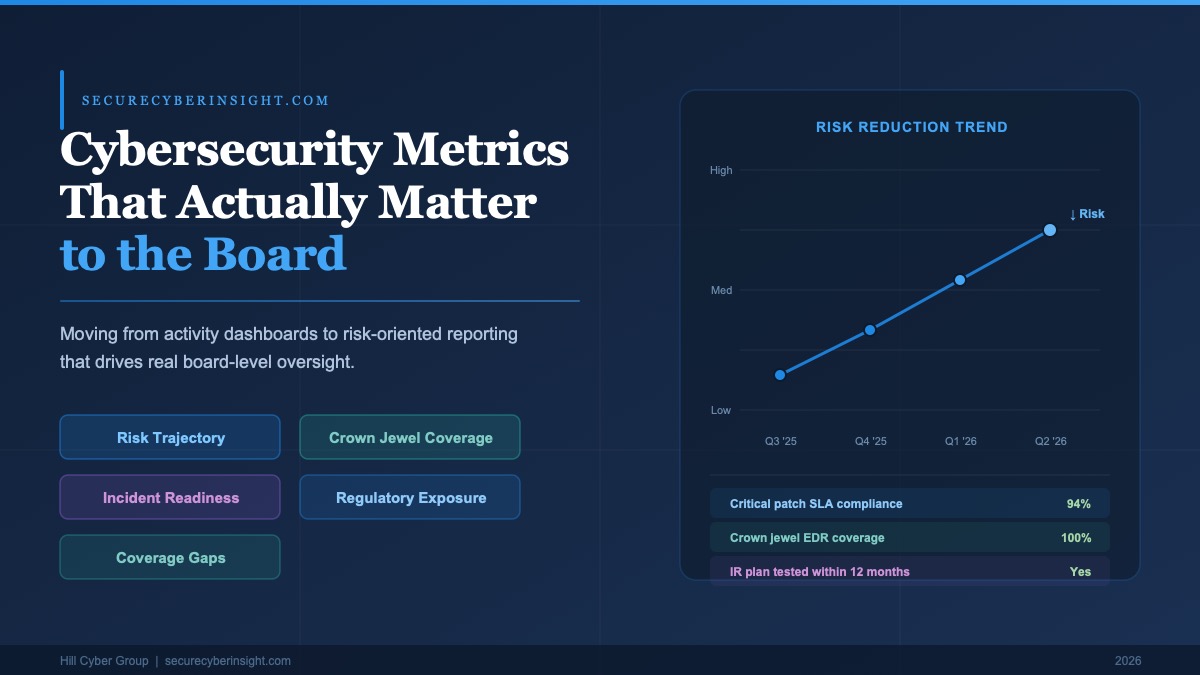
Bottom line: Board-level cybersecurity reporting should show risk reduction, crown jewel coverage, incident readiness, compliance exposure, and program gaps, not just operational activity counts.
Boards are under growing pressure to demonstrate meaningful cybersecurity oversight. The challenge is that most reporting they receive is operational: patch counts, vulnerability totals, phishing simulation rates, and ticket volumes. These numbers tell leadership how busy the security team is. They do not tell leadership whether the organization's risk is being effectively managed.
Effective board-level cybersecurity reporting requires a different set of metrics, ones that connect security activity to business risk, not just security workload.
Why most cybersecurity dashboards fall short at the board level
Security teams are trained to measure what they can control and count. That produces reliable operational metrics that are genuinely useful for the team running the program.
The problem is that volume metrics rarely translate into risk insight. A dashboard showing 1,247 vulnerabilities resolved this quarter could mean the program is working, or it could mean there are still thousands of unaddressed critical exposures across production systems. The number alone does not tell leadership which interpretation is correct.
Board members and senior executives need answers to a different set of questions:
- Are we better positioned against the threats most likely to affect us?
- Do we know where our most significant exposures are?
- Is there evidence that our security investment is reducing meaningful risk?
- Are we prepared to respond if something significant happens?
Metrics that answer these questions require more thought to construct, but they generate far more useful conversations.
Metrics worth including in board-level reporting
Risk reduction over time
The most important trend to show is whether the organization's residual risk is moving in the right direction.
This can be expressed several ways:
- Percentage of critical and high vulnerabilities remediated within defined SLA windows
- Reduction in exposed attack paths to high-value assets through network segmentation and privileged access controls
- Trend in third-party critical vendor risk ratings over rolling quarters
What matters is not a snapshot of current state but whether the trajectory is improving or degrading. Boards are well-equipped to understand trend data. Give them trends, not instantaneous counts.
Crown jewel coverage
Organizations have assets and data that, if compromised, would cause significantly greater harm than a typical incident. These often include customer data repositories, financial systems, intellectual property, authentication infrastructure, and core operational systems.
Board reporting should address whether defined crown jewels have adequate protective and detective controls in place:
- Are these systems covered by endpoint detection and response tooling?
- Are access controls reviewed and appropriate?
- Is privileged access to these systems managed and monitored?
- Is relevant logging in place and reviewed?
A simple coverage map for two to four of the highest-priority assets provides more actionable insight than a volume-based security score.
Incident readiness
Cybersecurity is partly about prevention and partly about being able to detect and respond when prevention fails. Board reporting should address readiness, not just prevention metrics.
Useful indicators include:
- When was the incident response plan last tested, and what did the test reveal?
- What is the mean time to detect and respond to confirmed incidents?
- Have key personnel completed incident response training in the current year?
- Are backup and recovery capabilities tested and verified?
These metrics tell leadership whether the organization could respond effectively if an incident occurred, which is ultimately the outcome that determines business impact.
Compliance and regulatory exposure
For regulated industries, board reporting should connect cybersecurity to the specific compliance obligations the organization faces.
This is not about checklist completion. It is about surfacing whether any open compliance gaps create material legal, regulatory, or reputational exposure. A summary identifying two or three open items with associated deadlines and remediation owners gives leadership the context they need without requiring a review of detailed findings.
Security program investment and coverage gaps
Boards have a governance responsibility to ensure appropriate resources are being allocated to cybersecurity. Reporting should periodically address whether current investment is sufficient relative to the organization's risk profile and regulatory environment.
This includes:
- Whether known coverage gaps exist due to resource or tooling constraints
- Whether third-party assessments or internal reviews have identified material findings not yet addressed
- Whether security staffing is aligned with the scope of the environment being defended
This is not a budget request. It is transparency that allows the board to exercise meaningful oversight.
What to leave out of board reports
Board and executive reports should not include raw vulnerability counts, patch statistics, phishing click rates as isolated numbers, or long technical narratives. These items belong in operational reporting for the security team and management, not in materials presented to the board.
The goal is not to hide operational detail. It is to present the right level of information for the audience. Boards and executives make decisions about risk tolerance, resource allocation, and strategic direction. Give them what they need to do that well.
A practical approach to getting started
If current board reporting is operationally focused and needs to shift toward risk-oriented metrics, the transition does not need to happen in a single quarter.
A reasonable starting point:
- Identify the three to five questions the board should be able to answer about cybersecurity after each reporting cycle.
- Determine what observable data would answer each question.
- Build the report around those questions and answers, using data to support the narrative rather than leading with data.
This framing, questions and answers with supporting evidence, usually produces cleaner, more useful reporting than a metric-first approach.
Bottom line
Cybersecurity board reporting that focuses on activity volume gives leadership comfort without insight. Metrics that reflect risk reduction, crown jewel coverage, incident readiness, compliance exposure, and program gaps give boards what they actually need to exercise effective oversight.
The shift from operational to risk-oriented reporting is not difficult, but it requires intentional design. The organizations that do it well have better board conversations, more appropriate resource allocation, and fewer surprises.