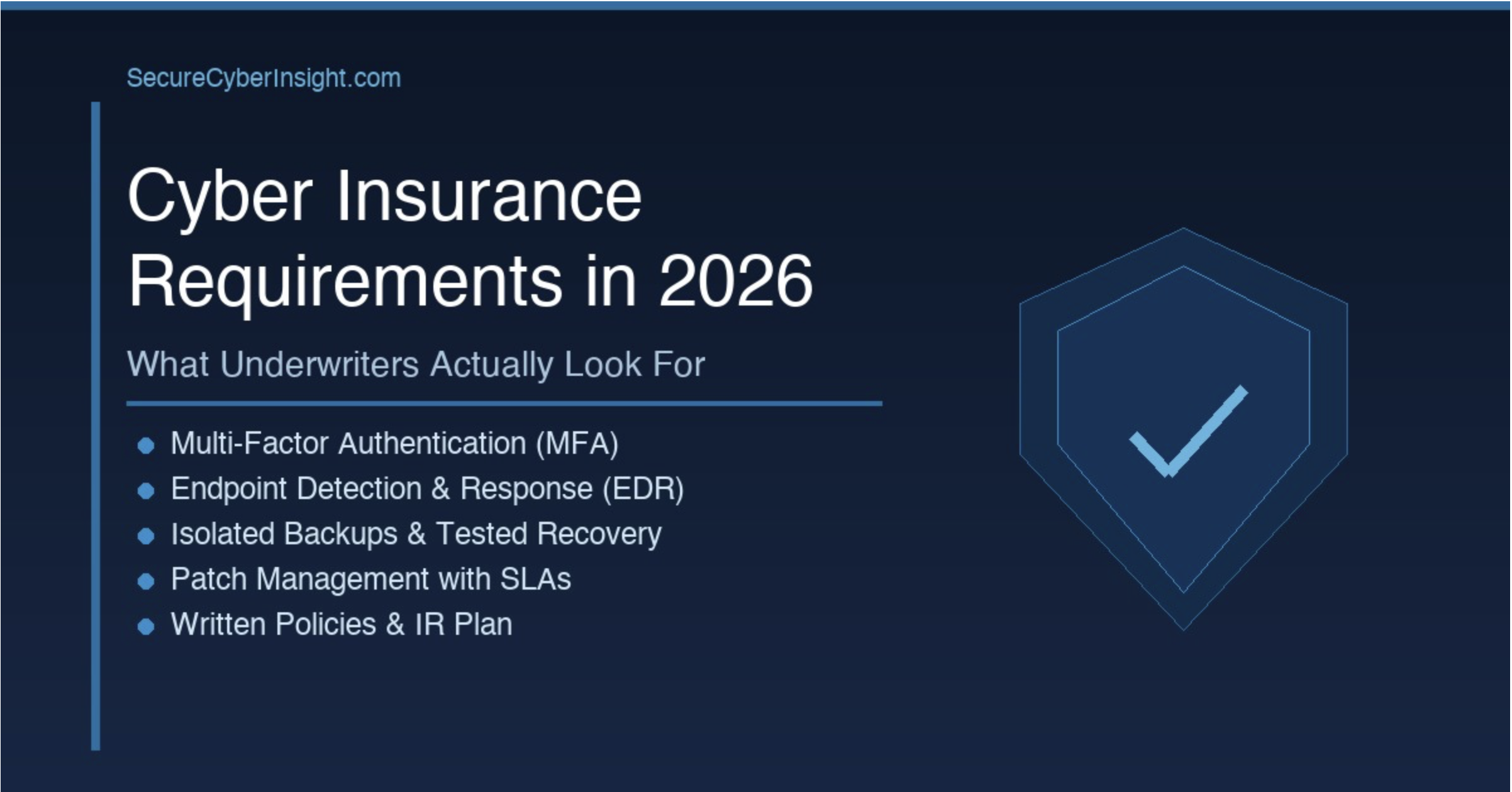
Bottom line: Cyber insurance applications now test the real condition of your security program. MFA, EDR, recoverable backups, patch management, and current documentation affect coverage terms, premiums, and claim outcomes.
Cyber insurance has changed significantly over the past several years. What used to be a relatively simple application process now involves detailed questionnaires, third-party assessments, and technical control requirements that closely mirror enterprise security frameworks.
Understanding what underwriters look for before you renew or apply puts you in a better negotiating position and reduces the risk of denied claims.
Why underwriter requirements have gotten stricter
The increase in ransomware attacks, large-scale data breaches, and cloud infrastructure incidents has pushed insurers to raise the bar on what coverage requires. Carriers that paid out on claims from organizations with weak controls have adjusted their models.
The result: insurers now ask whether specific technical controls are in place, not just whether a policy document exists. That distinction matters.
Controls that appear on nearly every application
Multi-factor authentication (MFA)
MFA coverage is a baseline requirement across almost every carrier. Underwriters ask specifically about:
- Email and collaboration platforms such as Microsoft 365 and Google Workspace
- Remote access and VPN
- Privileged accounts and administrator access
- Cloud management consoles and infrastructure portals
Partial MFA deployment is common and creates problems. An organization with MFA on standard user accounts but not on administrator accounts is still significantly exposed, and underwriters have learned to ask the follow-up question.
Endpoint detection and response (EDR)
Traditional antivirus is no longer sufficient for most carriers. EDR solutions that provide behavioral detection, containment capabilities, and centralized visibility across endpoints are expected.
Managed detection and response coverage, where a third party monitors and responds to alerts, is often viewed favorably and can reduce premiums. What matters is evidence that someone is watching and capable of acting.
Privileged access management and least privilege
Underwriters increasingly ask how privileged credentials are managed. Typical questions include:
- Are privileged accounts separated from standard user accounts?
- Are administrative credentials rotated regularly?
- Is just-in-time access or privilege elevation in use?
Organizations that allow persistent, always-on administrative access from individual workstations are viewed as higher risk and priced accordingly.
Backup strategy and tested recovery
Ransomware coverage has tightened considerably. Carriers want to know:
- Are backups isolated from the production environment?
- Are backup systems protected with separate credentials from production systems?
- How recently were backups tested for successful restoration?
Backups stored on systems accessible with the same credentials as production systems are frequently excluded from ransomware coverage or subject to significant premium increases. The question is not whether backups exist. It is whether they are actually recoverable under adversarial conditions.
Patch management
Questions about patch management have become more specific. Underwriters now ask about:
- Average time to apply critical patches after release
- Whether end-of-life software or operating systems are in use
- Whether a formal vulnerability management process exists with defined SLAs
A known critical vulnerability left unpatched for an extended period can void coverage for incidents traceable to that vulnerability, particularly if the underwriter's questionnaire addressed that class of control.
Documentation insurers want to see
Technical controls are one side of the equation. Documentation matters too.
Common requests include:
- A written information security policy reviewed and approved within the past year
- An incident response plan with named roles, escalation paths, and tested procedures
- Evidence of security awareness training completion across the workforce
- Third-party and vendor risk management records
- Access review records and documented off-boarding procedures
The absence of documentation does not automatically disqualify coverage, but it influences pricing, retention requirements, and coverage sublimits. Carriers use documentation as a signal of program maturity.
What happens when something is overstated on the application
Misrepresentation is the fastest path to claim denial. Underwriters are increasingly cross-referencing questionnaire responses against observable signals, including public vulnerability disclosures, threat intelligence data, and external scan results.
If an organization claims MFA is fully deployed but a claim involves an account compromise on an unprotected administrator account, the carrier will investigate the accuracy of the original disclosure. Overstating control maturity creates material legal and financial risk that outlasts the policy period.
A practical approach before renewal
The period before policy renewal is the right time to assess actual control state against what the application will say.
Key areas to review:
- MFA coverage map: which accounts, systems, and access paths are and are not protected
- EDR deployment completeness: are all endpoints covered, including servers and cloud workloads?
- Backup test records: when was the last verified successful restoration?
- Patch status: are any known critical vulnerabilities outstanding?
- Documentation currency: are key policies and the incident response plan current and accessible?
This review does not need to be exhaustive. A clear-eyed assessment of the areas most likely to affect coverage terms is usually sufficient to surface meaningful gaps before the application is submitted.
Bottom line
Cyber insurance requirements in 2026 reflect the actual threat landscape, not an abstract checklist. The controls underwriters ask about, including MFA, EDR, clean backups, patch management, and documented procedures, are the same controls that reduce the probability of a significant incident.
Organizations that treat insurance requirements as a compliance exercise often find they have the documentation but not the underlying control maturity. That gap shows up in both premiums and claims.
Knowing what underwriters actually look for before the application arrives is the simplest way to close that gap.