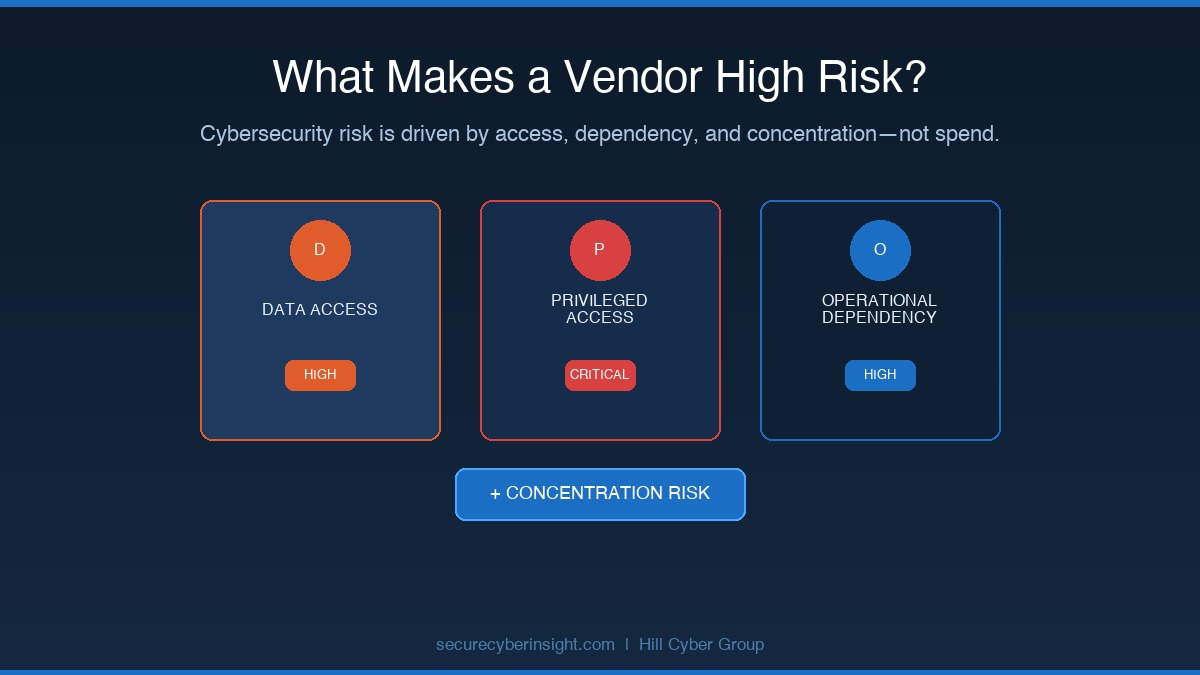
Bottom line: High-risk vendors are defined by access, dependency, and concentration exposure, not by contract value or frequency of use. If a vendor can reach sensitive data, operate with privilege, or disrupt critical operations, it deserves stronger oversight.
Every organization uses vendors. Most create no serious cybersecurity exposure. A small number can bring your operations down, expose your customers, or hand attackers a path through your defenses if something goes wrong.
Understanding which vendors fall into that second category and why is one of the most practical things a security or business leader can do.
Vendor importance is not the same as vendor risk
A vendor your finance team uses every day might be essential to operations but carry minimal cybersecurity risk. A vendor you interact with once a quarter might have deep access to your systems and data.
Spend, frequency of use, or how much employees like the tool do not determine risk. The factors that actually drive cybersecurity exposure are access, dependency, and what happens if that vendor fails or is compromised.
Four factors that increase vendor cybersecurity risk
1. Data access
The most direct driver of risk is what information a vendor can reach.
High-risk indicators include:
- access to personally identifiable information, financial records, or health data
- storage of credentials, encryption keys, or authentication tokens
- integration with regulated data systems such as banking, HR, or medical records
- the ability to move or export data outside your environment
A vendor that touches sensitive data creates exposure proportional to the sensitivity, volume, and regulatory classification of that data.
2. Privileged or administrative access
Some vendors need elevated access to do their work. Managed service providers, IT support firms, infrastructure vendors, and security tool providers often operate with administrative rights across core systems.
That level of access means a compromise of the vendor or even a single vendor employee could grant an attacker administrative control over your environment without breaching your perimeter directly.
Organizations should treat any vendor with admin, root, privileged account, or remote access capabilities as high risk by default.
3. Operational resilience exposure
Risk is not only about confidentiality. Some vendors create risk through dependency: if they fail, your operations fail with them.
This includes:
- core payment or transaction processing vendors
- cloud infrastructure or hosting providers
- identity and authentication services
- communication platforms critical to daily operations
- vendors supporting regulated or time-sensitive functions
When a vendor failure would trigger customer impact, regulatory reporting, or a business continuity response, that vendor warrants high-risk classification regardless of how the data exposure looks.
4. Concentration risk
Concentration risk is often overlooked. It occurs when multiple critical business functions depend on a single vendor or vendor family.
An organization that relies on one provider for email, file storage, identity management, and communication tools has amplified exposure. A single vendor incident can disable several critical capabilities at once.
Regulators and auditors increasingly scrutinize concentration, particularly in financial services environments where resilience expectations are explicit.
Why some low-spend vendors still create high exposure
Security and risk teams sometimes anchor vendor reviews to spend thresholds. That approach misses a category of vendors that are inexpensive to license but significant in terms of what they can access or affect.
Examples include:
- a browser extension with access to web session data
- a low-cost IT monitoring tool with agent software installed on every endpoint
- a third-party authentication plugin embedded in a customer-facing application
- a development tool with access to source code repositories
None of these require a large contract to create meaningful exposure. What matters is the access model, not the invoice total.
When a vendor should be treated as critical
A vendor should be elevated to critical status when one or more of the following applies:
- a breach of that vendor would likely require regulatory notification
- a failure would disable a core business function for an extended period
- the vendor holds or processes data that would create legal or reputational harm if exposed
- no practical substitute or fallback exists within a reasonable timeframe
- the vendor operates with standing administrative or privileged access
Critical vendors require more frequent review, stronger contractual security terms, and active monitoring. They should also be included in business continuity and incident response planning.
A practical starting point
Most organizations do not need a complex scoring model to get started. A short set of questions reviewed for each vendor can surface the high-risk population quickly:
- Does this vendor access, store, or process sensitive or regulated data?
- Does this vendor have privileged or remote access to our systems?
- Would our operations be materially affected if this vendor was unavailable for 24 hours? For a week?
- Are multiple critical functions dependent on this vendor?
- Has this vendor been vetted for security practices proportional to their access level?
Vendors that generate yes answers across several questions deserve a more thorough review, stronger contractual protections, and regular reassessment.
Bottom line
Not all vendors need the same level of oversight. What drives cybersecurity risk is not how often you use a vendor or what you pay them. It is what they can access, what they can break, and what happens to your customers and your organization when something goes wrong.
Identifying your high-risk vendors is the first step toward managing them. Without that visibility, third-party risk is not a program. It is a gap.