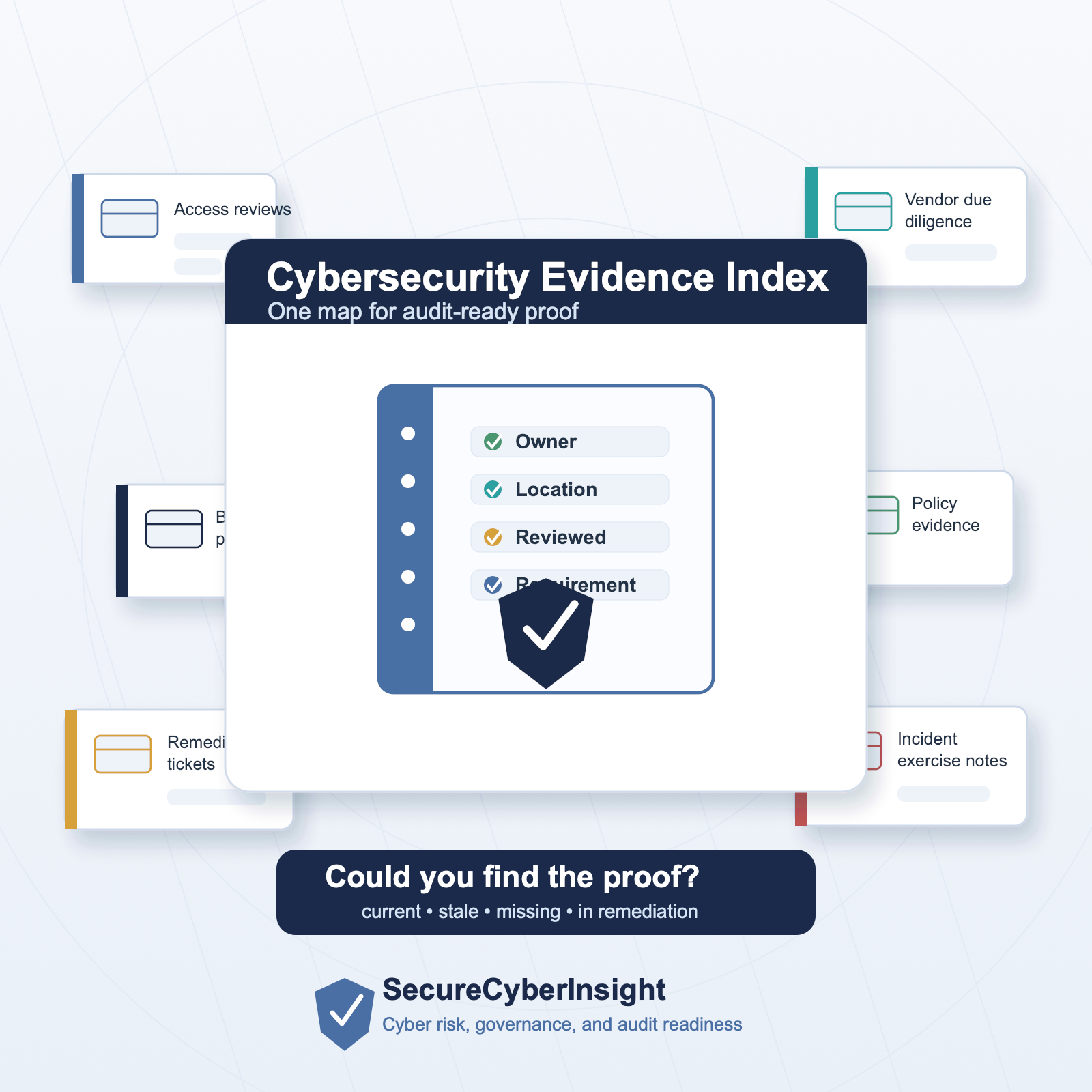
Executive takeaway: A cybersecurity evidence index helps leaders find, explain, and defend cybersecurity audit evidence before an auditor, examiner, customer, insurer, or board member asks for proof.
A cybersecurity audit rarely fails because the organization has no documents at all.
More often, the problem is that the right evidence is scattered across shared drives, ticketing systems, inboxes, vendor portals, spreadsheets, and individual laptops. When an auditor, examiner, customer, insurer, or board member asks for proof, the team knows the evidence exists somewhere, but no one can find it quickly or explain it consistently.
That is exactly the problem a cybersecurity evidence index is designed to solve.
An evidence index is a practical inventory of the records that support your cybersecurity program. It does not replace policies, procedures, risk assessments, or control testing. It gives those materials structure so the organization can find, maintain, and defend them when review pressure arrives.
Why an evidence index matters
Cybersecurity reviews are evidence-driven.
A reviewer may start by asking whether the organization has an access control policy, incident response plan, vulnerability management process, vendor risk program, or board reporting cadence. But the conversation usually moves quickly from policy language to operational proof.
They may ask:
- When was access last reviewed?
- Who approved the review?
- What exceptions were found?
- How were findings tracked to closure?
- Which critical vendors were assessed?
- What vulnerabilities remain open, and why?
- When was the incident response plan tested?
- What cybersecurity information is reported to leadership?
Without an index, teams often respond by searching from scratch. That creates delay, inconsistent answers, and unnecessary stress.
With an index, the organization has a map. It knows what evidence exists, who owns it, where it lives, when it was last reviewed, and which gaps still need attention.
What a cybersecurity evidence index should include
A useful evidence index does not need to be complicated. In many organizations, a controlled spreadsheet or governance tracker is enough to start.
At minimum, include these fields:
- Control area
- Evidence name
- Evidence description
- Evidence owner
- Storage location or system of record
- Last review or approval date
- Review frequency
- Related requirement, risk, or framework reference
- Evidence status
- Known limitation or open issue
- Next action and due date
The goal is not to create a paperwork exercise. The goal is to make evidence findable, current, and accountable.
Start with the evidence reviewers usually ask for first
The easiest way to build an index is to begin with high-value evidence categories instead of trying to inventory every security record at once.
Start with:
- Information security policy and supporting standards
- Access control policy and access review records
- User provisioning and termination evidence
- Privileged access review evidence
- Vulnerability management procedure and remediation status
- Patch management records
- Incident response plan and tabletop exercise materials
- Backup and recovery testing evidence
- Vendor inventory and critical vendor due diligence files
- Risk assessment and risk register
- Cybersecurity exceptions and accepted risks
- Open findings and remediation plans
- Security awareness training records
- Executive or board cybersecurity reporting samples
These areas appear often in audits, exams, customer due diligence reviews, cyber insurance renewals, and internal governance discussions.
Map evidence to ownership
An evidence index is only useful if ownership is clear.
Every evidence item should have a named owner or accountable role. That owner does not have to perform every control activity personally, but someone must be responsible for keeping the evidence current and explaining it when asked.
For example:
- IT may own vulnerability scan results and patch remediation records.
- HR or IT may own user termination evidence.
- Security, compliance, or risk may own the risk register and exception log.
- Procurement or vendor management may own critical vendor due diligence records.
- Executive leadership may own board reporting materials and risk acceptance decisions.
If no owner can be named, that is not just an indexing problem. It is a governance gap.
Use locations that reviewers and internal teams can trust
The storage location field should point to a controlled source, not a vague folder description.
Avoid entries such as:
- “Shared drive”
- “In email”
- “Ask John”
- “Vendor portal somewhere”
Use specific locations instead:
- Document repository path
- GRC system record
- Ticket queue or report link
- Vendor management platform record
- Board packet archive location
- Approved policy library location
The index should help someone find evidence without relying on institutional memory.
Track status honestly
An evidence index should not pretend everything is complete.
Useful status values may include:
- Current
- Needs review
- Missing owner
- In remediation
- Evidence incomplete
- Not applicable
- Pending approval
Honest status tracking helps leadership see where review exposure exists before an external party finds it. It also reduces the temptation to assemble weak or outdated evidence at the last minute.
Connect evidence to risks and requirements
Evidence becomes more useful when it is tied to the reason it exists.
For each evidence item, note the related risk, requirement, framework domain, contractual obligation, policy requirement, or audit expectation. This does not require a complex control matrix at first. A simple reference is enough to show why the evidence matters.
For example:
- Quarterly access review evidence may support access control, least privilege, and user lifecycle management expectations.
- Vendor due diligence files may support third-party risk management and business resilience expectations.
- Incident response tabletop records may support incident preparedness, escalation, and recovery planning expectations.
- Board cybersecurity reports may support governance and executive oversight expectations.
This connection helps the organization reuse evidence across different review types.
Review the index before review season
An evidence index should be maintained during normal operations, not built during the week before an audit.
A practical cadence may include:
- Monthly updates for active remediation items
- Quarterly checks for access reviews, vulnerabilities, exceptions, and vendor risk items
- Semiannual checks for incident response, backup testing, and executive reporting evidence
- Annual confirmation of policies, risk assessments, and major governance documents
The cadence should match the organization’s size, risk profile, regulatory exposure, and available staff.
Questions leaders should ask
Executives and board-facing leaders do not need to inspect every evidence file. They do need confidence that the organization can support its cybersecurity claims.
Useful questions include:
- Which evidence would be hardest to produce today?
- Which critical control areas have stale or incomplete evidence?
- Which evidence items have no clear owner?
- Which open findings or exceptions are past due?
- Are vendor risk records current for critical vendors?
- Can we explain known gaps clearly and show a remediation plan?
- Could we respond to an auditor, examiner, insurer, or customer without rebuilding the evidence package from scratch?
These questions move cybersecurity oversight from assumption to proof.
A simple first-week action plan
Organizations can make progress quickly by starting small.
In the first week:
- Pick ten evidence categories most likely to be requested.
- Identify the current location for each evidence item.
- Assign an owner for each item.
- Record the last review date.
- Mark the status honestly.
- Capture known gaps or missing approvals.
- Set one next action for each weak item.
That first version will not be perfect, but it will expose the biggest readiness gaps and create a foundation the team can improve.
Final thought
Audit readiness is not only about having cybersecurity compliance documentation. It is about being able to prove what is current, what is operating, who owns it, and what still needs work.
A cybersecurity evidence index gives organizations a practical way to reduce last-minute scrambling, improve accountability, and support stronger conversations with auditors, examiners, customers, insurers, and leadership.
If the organization cannot find and explain its control evidence during a quiet week, it will struggle when review pressure arrives. Building the index now is one of the simplest ways to make the next cybersecurity review more controlled, more honest, and more defensible.