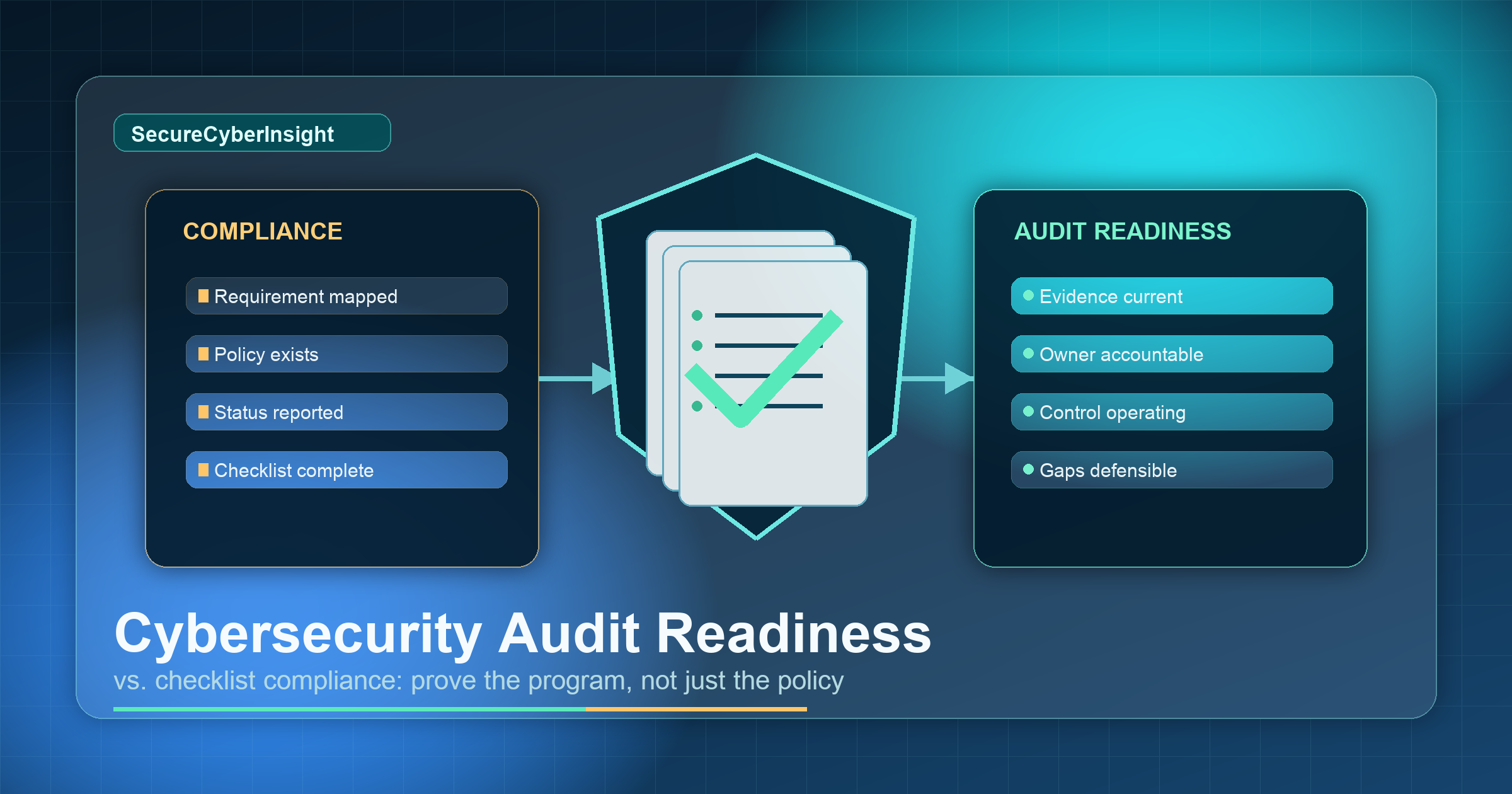
Executive takeaway: Compliance maps the requirement. Audit readiness proves the cybersecurity program can support its claims with current evidence, clear ownership, and defensible explanations under review pressure.
A cybersecurity program can look compliant on paper and still fail under review pressure.
That is the risk many organizations discover when an auditor, examiner, customer, insurer, or board member asks for proof.
Compliance and audit readiness are connected, but they are not identical. Compliance is usually tied to a defined obligation. Audit readiness is the ability to show that cybersecurity controls are current, owned, operating, evidenced, and understood.
The difference matters because reviewers are not only looking for policy language. They are looking for proof that the organization can govern cybersecurity risk in a repeatable way.
Compliance answers a requirement. Audit readiness proves the program.
Compliance usually starts with a specific standard or expectation. That may include a regulation, contractual obligation, customer requirement, cyber insurance questionnaire, internal policy requirement, or cybersecurity framework.
Common examples include NIST Cybersecurity Framework, CIS Controls, ISO 27001, SOC 2, GLBA, HIPAA, PCI DSS, FFIEC expectations, and customer security questionnaires.
Compliance work helps organizations identify what they are expected to do. It often includes:
- mapping controls to requirements
- identifying policy and procedure needs
- assigning control owners
- collecting required documentation
- tracking gaps against a standard
- reporting compliance status to leadership
That work is valuable. It gives structure to the cybersecurity program.
But a compliance map is not the same thing as audit-ready evidence.
The most common mistake: confusing policy existence with operational proof
Many organizations can produce a policy faster than they can prove the control actually operated.
That is a readiness problem.
A policy describes intent. Evidence demonstrates performance.
For example:
- An access control policy says access should be reviewed.
- Access review evidence shows who reviewed access, when the review occurred, what exceptions were found, and how issues were resolved.
The same distinction applies across incident response, vulnerability management, vendor risk management, backup testing, security awareness training, exception approvals, risk assessments, and executive reporting.
A reviewer may accept that the organization has a policy. But the deeper question is whether the organization can prove the policy is alive in day-to-day operations.
What cybersecurity audit readiness really means
Cybersecurity audit readiness means the organization can respond to review requests without panic, confusion, or improvised explanations.
An audit-ready organization can usually provide:
- current and approved cybersecurity policies
- procedures that match actual practice
- control evidence for key security activities
- named owners for major cybersecurity control areas
- risk registers, exceptions, and remediation records
- vendor oversight documentation
- vulnerability management and patching records
- incident response planning and exercise evidence
- executive or board reporting materials
- a clear explanation of known gaps and next steps
Readiness does not mean every control is perfect. It means the organization knows what it has, knows what it lacks, and can support its statements with credible evidence.
Why audit readiness helps beyond formal compliance
Cybersecurity reviews do not only come from formal audits.
The same evidence may be needed for:
- customer security questionnaires
- third-party due diligence reviews
- regulatory exams
- bank examinations
- cyber insurance renewals
- internal audit reviews
- board oversight discussions
- merger and acquisition due diligence
- vendor onboarding reviews
Organizations that only prepare for one compliance event often rebuild the evidence package from scratch every time.
Organizations that maintain readiness can reuse a trusted evidence foundation. They still tailor the response to each audience, but they are not starting from zero.
How to build a practical cybersecurity evidence index
One of the simplest ways to improve audit readiness is to build an evidence index.
An evidence index is a structured list of the documents, records, owners, and locations that support the cybersecurity program.
At minimum, it should track:
- control area
- evidence name
- document owner
- storage location
- last review date
- related requirement or risk
- known limitation or open issue
This helps teams avoid the common “we have it somewhere” problem.
It also makes leadership reporting more realistic because open gaps and stale evidence become visible before an external review begins.
Questions executives should ask before the next cybersecurity review
Leaders do not need to inspect every evidence file. They do need to know whether the organization can defend its program.
Useful questions include:
- Which cybersecurity controls would be hardest to evidence today?
- Which policies are overdue for review or approval?
- Where do we have unresolved findings or exceptions?
- Which vendors create the highest review exposure?
- Can we produce access review, vulnerability management, and incident response evidence quickly?
- What would an auditor, examiner, insurer, or customer see as our biggest documentation weakness?
These questions move the conversation beyond “Are we compliant?” and toward “Are we ready to prove it?”
A simple readiness improvement plan
Organizations can improve cybersecurity audit readiness without trying to solve everything at once.
Start with the evidence most likely to be requested first:
- information security policy
- access control policy and access review records
- incident response plan and exercise documentation
- vulnerability management procedure and remediation status
- vendor inventory and critical vendor review files
- risk assessment and risk register
- open findings, exceptions, and remediation plans
- executive or board reporting samples
Then assign owners, confirm current versions, set review dates, document known gaps, and test whether the evidence package can be produced quickly.
If the team cannot find and explain the material during a quiet week, it will struggle under audit pressure.
Final thought
Compliance defines the expectation. Audit readiness proves the organization can support its cybersecurity claims.
The strongest programs connect both. They map requirements, maintain evidence, keep ownership clear, document exceptions, track remediation, and give leaders a truthful view of what can be defended today.
That is what separates checklist compliance from real cybersecurity audit readiness.