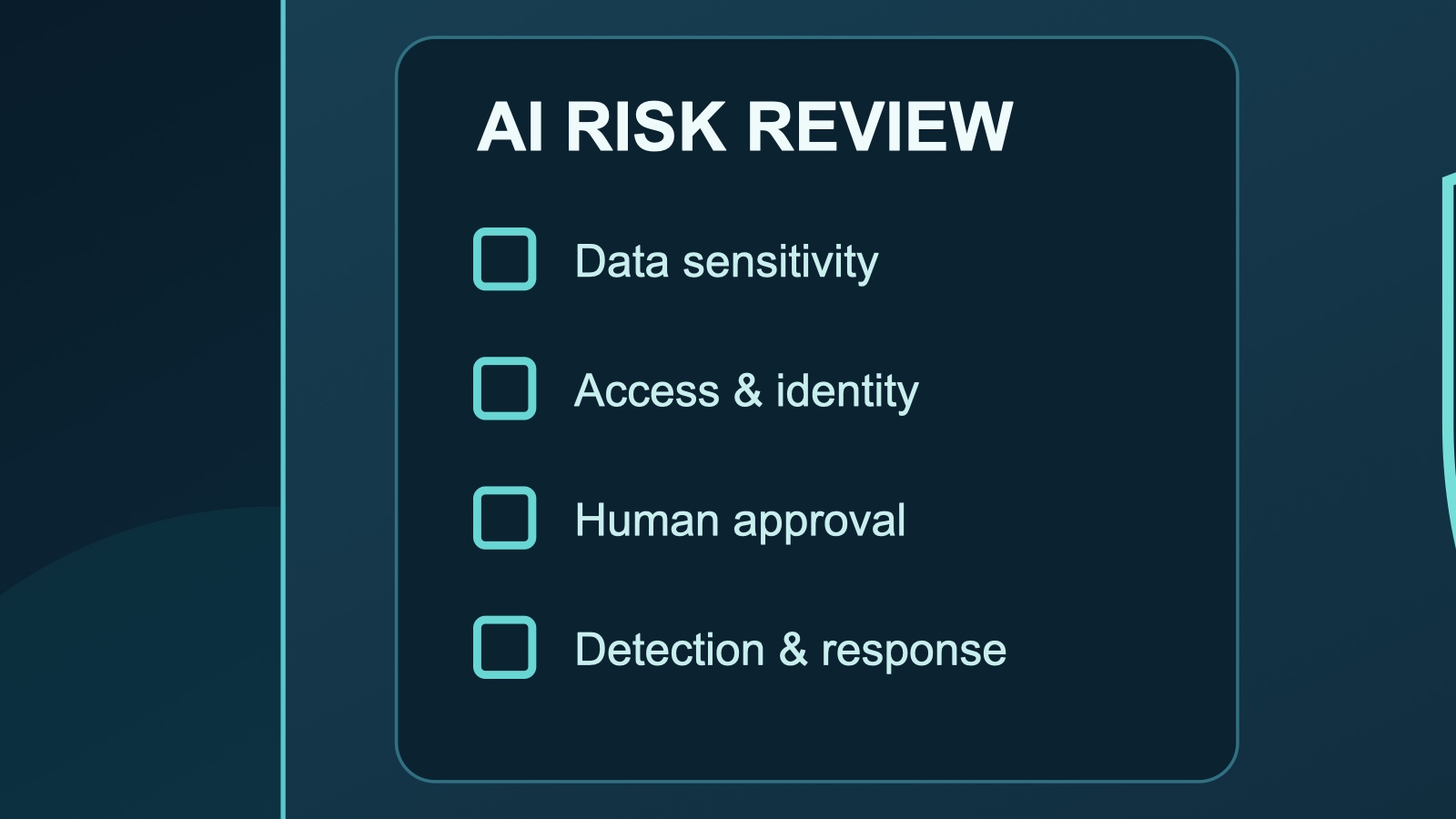
Artificial intelligence is now built into productivity suites, customer platforms, development tools, and industry software. For small and mid-sized businesses, the challenge is no longer deciding whether AI exists in the environment. The challenge is determining which uses create meaningful risk and which controls are proportionate.
An AI cybersecurity risk assessment gives leaders a repeatable way to evaluate a tool before approval and to review important uses after deployment. It should focus on business impact, data, access, automation, vendor practices, monitoring, and recovery—not on technical novelty.
Start with the business use case
Assess the specific use, not AI in the abstract. The same product can present very different risks depending on what employees ask it to do and what systems it can reach.
Document:
- The business purpose and accountable owner
- The users, departments, and affected customers
- The decisions or actions the tool supports
- Whether output is advisory, customer-facing, or automatically executed
- The business impact of inaccurate, unavailable, manipulated, or exposed results
- The manual fallback if the service cannot be trusted
A low-impact writing assistant used with public information may need basic safeguards. An agent that reads customer records, changes account data, or sends external messages deserves a deeper review.
Identify the data involved
Map information through the complete AI workflow. Consider prompts, uploaded files, retrieved documents, generated output, logs, feedback, and data passed through integrations.
Ask:
- Will the tool handle personal, financial, health, customer, employee, legal, or confidential business information?
- Can users accidentally submit restricted data?
- Does the provider retain prompts, files, or output?
- Is customer content used to train shared models?
- Where is data stored and processed?
- Can administrators set retention periods and delete records?
- Do subprocessors receive any content?
Apply the organization's existing data-classification rules. If those rules prohibit a data type from being entered into an unapproved cloud service, adding AI does not create an exception.
Review identities, permissions, and integrations
AI tools become more consequential when they can retrieve data or take action. Review both human accounts and non-human identities such as service accounts, API keys, agents, and application connections.
Verify:
- Enterprise accounts, single sign-on, and multifactor authentication are used where available
- Access is role-based and removed when users change jobs or leave
- Connected repositories, mailboxes, drives, and applications are limited to the business need
- Service credentials are stored securely and rotated
- High-impact actions require human approval
- Administrative roles are restricted and periodically reviewed
- Integration changes generate an auditable record
Test permissions from the perspective of an ordinary user. A policy may say access is limited while the actual connector can search an entire shared drive.
Evaluate output and automation risk
AI output can be inaccurate, incomplete, biased, manipulated, or inconsistent. The assessment should define how mistakes will be detected before they cause harm.
For each workflow, decide:
- What a qualified person must review
- Which sources or evidence the reviewer should verify
- What confidence threshold or exception requires escalation
- Which actions the AI must never perform automatically
- How customers or employees can challenge a decision
- How the organization will identify prompt injection or untrusted content
- Whether generated code receives normal security testing and peer review
Human review must be meaningful. A rushed click on an approval button is not an effective control if the reviewer lacks context, authority, or time.
Assess the provider and contract
A vendor's security page is a starting point, not the complete review. Obtain evidence appropriate to the use and its risk.
Review:
- Independent assurance reports and relevant certifications
- Vulnerability management and secure development practices
- Incident-notification commitments
- Data ownership, training, retention, deletion, and subprocessors
- Administrative controls, audit logs, and export capabilities
- Model, feature, and terms-of-service change notifications
- Business continuity, service availability, and exit support
- Responsibility for integrated third-party models or plugins
Record unresolved issues and decide whether compensating controls reduce the risk enough to proceed. A business owner should formally accept material residual risk rather than allowing silence to become approval.
Define logging and detection
The organization needs enough visibility to detect misuse and investigate incidents without collecting unnecessary sensitive content.
Confirm that logs can show:
- Sign-ins and failed authentication
- User, administrator, and service-account activity
- File uploads, sensitive-data events, and unusual usage volume
- Permission, connector, model, and configuration changes
- Actions taken by agents or automated workflows
- Policy violations and security alerts
- Export, deletion, and retention activity
Assign a person or team to review relevant events. A logging feature has little value if nobody receives alerts or knows when to escalate.
Prepare response and recovery steps
Add the assessed AI use to existing incident-response and continuity processes. Plan for confidential-data exposure, compromised accounts, malicious input, incorrect automated action, provider incidents, and service outages.
The team should know how to:
- Disable the user, integration, or agent.
- Revoke sessions, tokens, and service credentials.
- Preserve logs and identify affected data and actions.
- Contact the provider and internal decision-makers.
- Correct records or communications produced by the workflow.
- Evaluate contractual, legal, regulatory, and customer-notification duties.
- Restore service only after access and configuration are trusted.
- Use a manual fallback while the tool remains unavailable.
Test at least one scenario before relying on the workflow for important operations.
Use a simple risk-rating method
An SMB does not need a complex scoring engine. Rate each use as low, moderate, or high across five factors:
- Data sensitivity: public information versus regulated or confidential data
- Access: isolated tool versus broad access to business systems
- Autonomy: recommendations versus actions without prior approval
- Impact: minor inconvenience versus customer, financial, safety, legal, or operational harm
- Detectability: obvious errors versus failures that may remain hidden
Any use with highly sensitive data, broad privileged access, autonomous consequential action, or potentially severe impact should receive enhanced review and executive approval. Reassess when the provider, model, integration, data, or business process changes.
A practical approval record
Keep the result short enough to maintain. A useful record includes:
- Tool, provider, business use, owner, and review date
- Data categories and connected systems
- Users, roles, and service identities
- Key vendor and contractual findings
- Required safeguards and evidence
- Risk rating and unresolved issues
- Approver and review expiration date
- Incident contact and fallback process
Set an expiration date. AI services change quickly, and an approval should not remain valid indefinitely when features, models, data practices, or integrations have changed.
The bottom line
An effective AI cybersecurity risk assessment connects a real business use to practical controls. Identify the data. Limit access. Require meaningful human review. Verify vendor commitments. Monitor important activity. Prepare for failure and change.
Start with the AI uses that touch sensitive information or can take consequential action. A concise assessment with named owners, documented evidence, and an expiration date gives SMB leaders a defensible way to enable useful AI without accepting invisible risk.
Secure Cyber Insight helps small and mid-sized organizations build practical cybersecurity and AI governance programs. If your organization needs a repeatable review process, begin with one high-impact AI workflow and use the checklist above to document its risk, controls, owner, and next review date.