# How SMBs Can Apply the NIST Cybersecurity Framework to AI Systems
Artificial intelligence is becoming part of everyday business operations. Employees use AI assistants to draft documents, summarize meetings, analyze data, write code, and support customers. Vendors are also adding AI features to software that organizations already depend on.
These tools can improve productivity, but they also introduce familiar cybersecurity risks in new forms. Sensitive information may be entered into an unapproved service. An AI-enabled application may receive more access than it needs. Generated content may be trusted without review. A vendor may retain prompts or use business data in ways the customer did not expect.
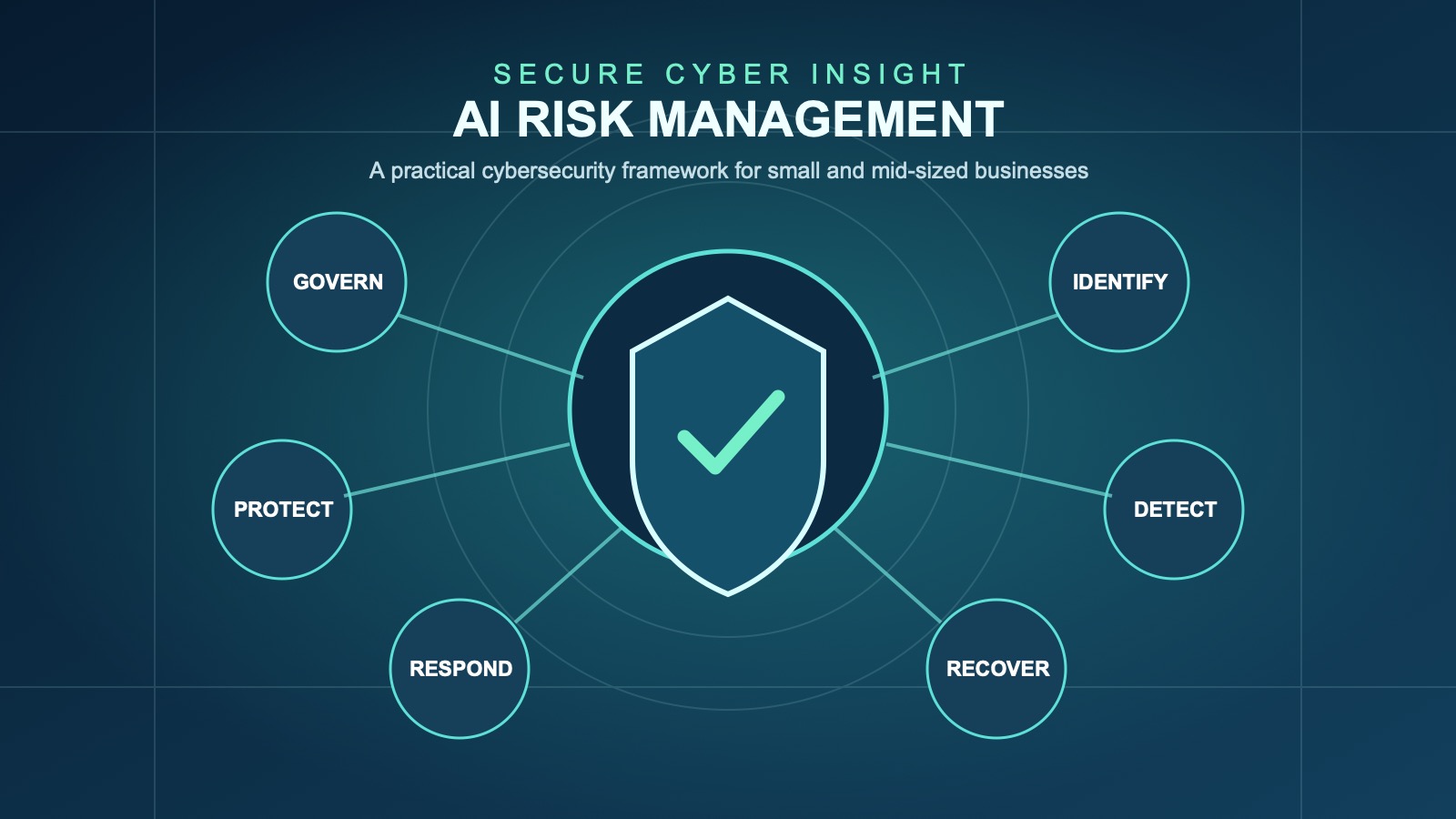
Small and mid-sized businesses do not need a separate security program for every AI product. NIST Cybersecurity Framework 2.0 provides a practical structure for managing AI-related risk alongside existing cybersecurity work. Its six functions—Govern, Identify, Protect, Detect, Respond, and Recover—can help an organization turn broad AI concerns into owned, testable controls.
Govern: set ownership and acceptable-use rules
AI security begins with governance. Assign an executive owner for AI risk and identify the people responsible for security, privacy, legal review, procurement, and business use. In a smaller organization, one person may fill several roles, but the responsibilities should still be explicit.
Create a short acceptable-use standard that answers the questions employees face:
- Which AI tools are approved?
- What information may employees enter?
- Which uses require human review?
- Who can authorize a new AI tool or integration?
- How should suspected data exposure or harmful output be reported?
- When must customers or business partners be told that AI is involved?
Connect these rules to existing policies for data classification, vendor management, software acquisition, access control, records retention, and incident response. AI should not become an exception to normal governance.
Identify: know where AI is used and what it can reach
An organization cannot protect AI use that it has not identified. Build a simple AI inventory covering approved tools, embedded vendor features, experimental uses, and important automated workflows.
For each entry, record:
- Business owner and purpose
- Provider, product, and model when known
- Users and affected business processes
- Data entered, generated, stored, or shared
- Systems, files, mailboxes, and applications the tool can access
- Retention, training, and deletion settings
- Human-review requirements
- Vendor contract and security-review status
- Business impact if the service fails or produces an incorrect result
Prioritize tools that handle regulated information, confidential business data, customer communications, financial decisions, software code, or privileged system access. These uses deserve stronger review than low-risk brainstorming with public information.
Protect: limit data, access, and autonomous action
Apply the same protection principles used for other systems. Start with least privilege. An AI assistant that only summarizes selected documents should not have access to every shared drive. An agent that schedules meetings should not automatically gain permission to send external email, modify customer records, or approve transactions.
Practical safeguards include:
- Approved enterprise accounts instead of unmanaged personal accounts
- Single sign-on and phishing-resistant multifactor authentication where available
- Role-based access to AI tools and connected data sources
- Default restrictions on confidential, personal, regulated, and customer data
- Vendor settings that prevent customer prompts and files from training shared models
- Encryption and appropriate retention limits
- Human approval before external communication, payments, access changes, or destructive actions
- Secure development review for AI-generated code
- Contract terms covering data use, subprocessors, security incidents, deletion, and service changes
Treat prompts, retrieved documents, system instructions, generated output, and action logs as potentially sensitive records. Their protection should match the information they contain.
Detect: monitor for unsafe use and unusual behavior
Traditional security monitoring still matters. Review sign-ins, access changes, data transfers, administrative actions, and vendor alerts. Add AI-specific visibility where the product supports it.
Useful indicators include:
- A sudden increase in prompts, file uploads, or API activity
- Access from an unusual location or unmanaged device
- Connections to newly authorized repositories or business systems
- Attempts to retrieve restricted data
- Unexpected changes to model, agent, plugin, or integration settings
- Repeated policy violations or bypass attempts
- Output that triggers external actions outside the approved workflow
Logging should support investigation without collecting more sensitive content than necessary. Define who reviews alerts, what requires escalation, and how long logs are retained.
Respond: add AI scenarios to the incident plan
Do not wait for an AI incident to decide who should act. Update the existing incident-response plan with realistic scenarios such as:
- An employee pasted confidential data into an unapproved AI service.
- A compromised AI account accessed connected business records.
- An AI agent sent an unauthorized message or changed data.
- A vendor disclosed a security incident involving prompts or uploaded files.
- AI-generated code introduced a vulnerability.
- Manipulated input caused a tool to ignore instructions or expose information.
Response steps may include disabling the account or integration, revoking tokens and sessions, preserving relevant logs, identifying affected data, contacting the provider, correcting unauthorized actions, and evaluating legal or customer notification obligations.
Employees need a clear reporting path. A fast report about an accidental upload is more valuable than silence caused by fear of punishment.
Recover: restore trusted operations and improve controls
Recovery means more than turning a tool back on. Confirm that access is appropriate, compromised credentials have been replaced, unauthorized integrations have been removed, affected records have been corrected, and stakeholders have received necessary updates.
Document what failed. Was the tool unapproved? Did procurement miss a data-use term? Were permissions too broad? Did the workflow lack human review? Use the answer to improve policy, training, technical controls, and vendor oversight.
For important AI-enabled workflows, identify a fallback process. Employees should know how to continue critical work if the provider is unavailable, the output cannot be trusted, or the integration must be disabled during an investigation.
A practical 30-day implementation plan
An SMB can make meaningful progress without launching a large compliance project.
Week 1: Govern and identify
- Name the executive owner and operational lead.
- Publish a short list of approved and prohibited AI uses.
- Ask department leaders to identify AI tools and embedded features in use.
- Create an inventory with owners, data types, access, and business purpose.
Week 2: Prioritize and protect
- Rank uses by data sensitivity, access, autonomy, and business impact.
- Remove unnecessary permissions and integrations.
- Confirm authentication, retention, training, and data-sharing settings.
- Require human approval for high-impact actions and external content.
Week 3: Monitor and prepare
- Enable available audit logs and security alerts.
- Define who reviews AI-related events.
- Add two or three AI scenarios to the incident-response plan.
- Give employees a simple reporting channel.
Week 4: Test and improve
- Test a suspected confidential-data upload or compromised AI account.
- Verify that the team can revoke access and preserve logs.
- Review one high-risk vendor contract and security profile.
- Record corrective actions, owners, and deadlines.
Questions to ask every AI vendor
Procurement and security teams should obtain clear answers before approving a high-risk tool:
- Does the provider use customer content to train shared models?
- Where is customer data stored and processed?
- Which subprocessors can access it?
- What administrative controls and audit logs are available?
- Can the organization control retention and delete its data?
- How are vulnerabilities and security incidents communicated?
- What happens to data when the service ends?
- Can the provider materially change models, features, or data practices without notice?
- Which independent security assessments or certifications apply?
Answers should be documented, not assumed from marketing language.
The bottom line
AI creates new workflows, but many of the controls needed to manage it are already familiar. Assign ownership. Inventory tools and data. Limit access. Monitor important activity. Prepare for incidents. Restore trusted operations and learn from failures.
Using the NIST Cybersecurity Framework for AI systems gives SMBs a common structure for this work. Start with the highest-risk use case, apply the six functions, and document decisions. A small set of clear, enforced controls is more valuable than a long AI policy that no one can follow.
Secure Cyber Insight helps small and mid-sized organizations build practical cybersecurity and AI governance programs. If AI tools have entered your business faster than your policies and controls, begin with an inventory and a risk-based review of the systems that handle sensitive data or can take consequential actions.