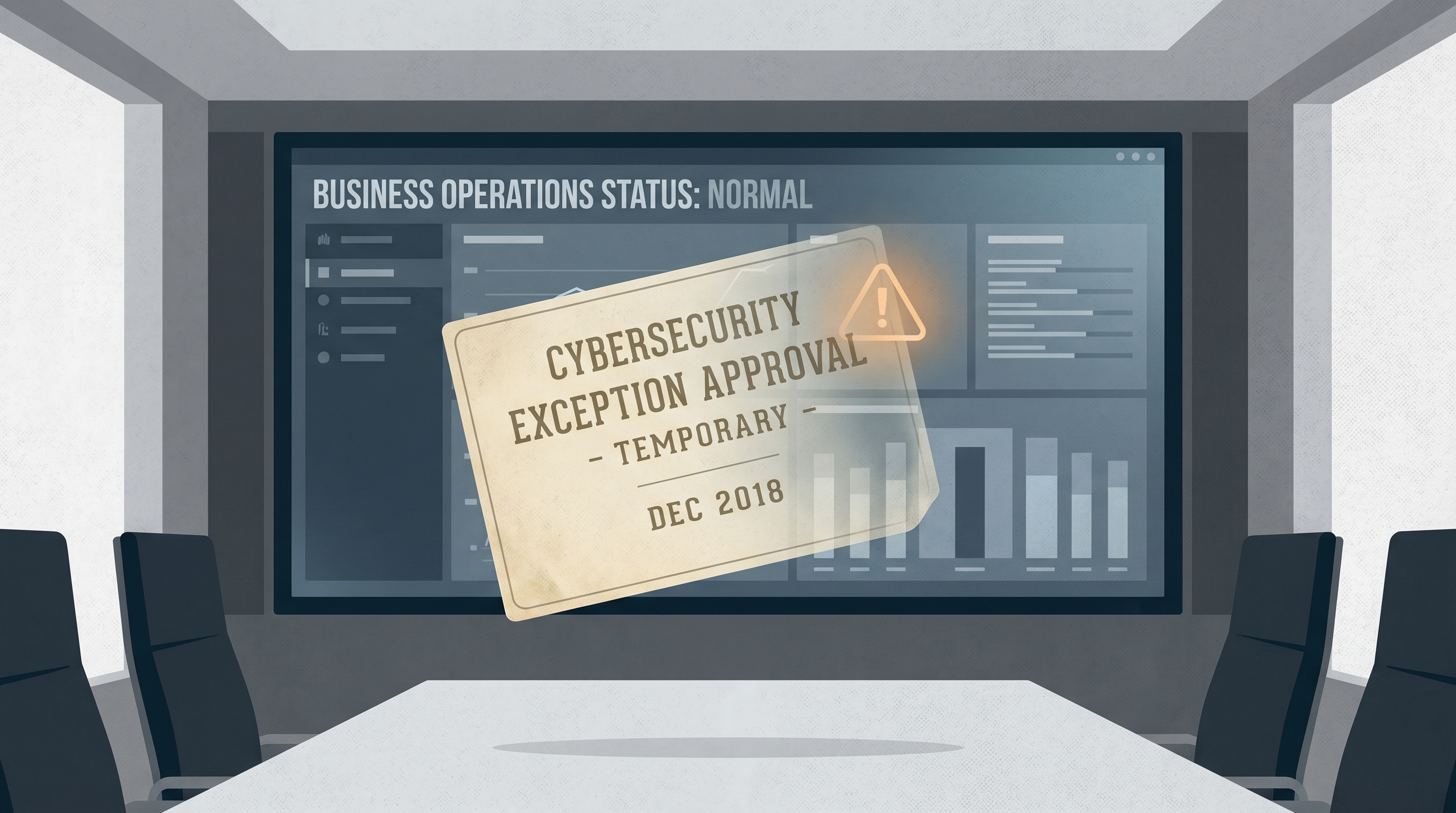
Executive takeaway: Cybersecurity exceptions become dangerous when they are approved as temporary accommodations but managed like permanent workarounds. A stronger exception process forces ownership, review, compensating controls, and real decisions at expiration.
Temporary cybersecurity exceptions have a way of becoming permanent.
A vendor needs broader access for a short-term integration. A team delays multi-factor authentication because of an application issue. An administrator keeps elevated privileges until a project is finished. A legacy system gets a policy waiver because replacing it will take time.
Each decision can sound reasonable in isolation.
The problem is not always the exception itself. The real problem is what happens next, or more often, what does not happen next.
Many organizations approve an exception, document it somewhere, and move on. Weeks turn into quarters. Ownership gets fuzzy. The business adapts to the workaround. The exception stops feeling temporary and starts feeling normal.
That is when a temporary accommodation becomes a durable control weakness.
Why Cybersecurity Exceptions Create Hidden Business Risk
Cybersecurity exceptions are often treated as documentation items or technical carve-outs. In reality, they are risk decisions.
An exception means the organization knows a normal requirement is not being met and is choosing to accept, defer, or work around that gap for a period of time.
That can be appropriate. Businesses do need practical flexibility. Systems break. Acquisitions introduce inherited complexity. Vendors sometimes require transitional access. Legacy applications do not always support modern controls cleanly.
But every exception creates a management obligation.
Leaders should be able to answer:
- What risk is being accepted?
- Why is the exception necessary?
- Who approved it?
- What compensating controls exist?
- When does it expire?
- Who is responsible for closing it?
- What happens if it is still open at the review date?
If those answers are unclear, the organization is not really managing the exception. It is simply living with unmanaged exposure.
What Goes Wrong in Practice
Most exception programs do not fail because people refuse to document them. They fail because the process is too weak to force a later decision.
1. No real expiration discipline
The exception form says it expires in 90 days, but nobody is required to revisit it in 90 days. The date exists on paper and nowhere else.
2. Weak ownership
The technical team assumes the business owner is accountable. The business owner assumes IT will handle it. Risk, compliance, and operations may all be aware of the issue, but nobody is clearly responsible for driving closure.
3. Vague business justification
An exception gets approved with language like operational need or system limitation without clearly stating why the requirement cannot be met now and what the actual business dependency is.
4. No compensating-control review
An organization may waive one control without asking what temporary protections should be added around the gap. That turns a bounded exception into a wider vulnerability.
5. Renewal by inertia
Instead of re-evaluating whether the exception is still justified, organizations simply extend it because fixing the issue is still inconvenient.
6. No leadership visibility
Senior leaders often hear about policy exceptions only after an audit issue, incident, or exam finding makes them impossible to ignore.
Why This Matters Beyond Compliance
Weak exception handling is not just an administrative problem.
It affects how much risk the business is actually carrying and whether leadership has a realistic picture of the control environment.
Unmanaged exceptions can lead to:
- Prolonged privileged access
- Delayed remediation of known weaknesses
- Unsupported legacy systems staying in production longer than intended
- Third-party access persisting without current business need
- Audit findings tied to poor governance and weak evidence
- Incident exposure that was technically known but operationally ignored
This is one reason many security failures feel surprising to executives even when the underlying issue was not truly unknown.
The organization knew there was a gap. It just never forced a decision about it.
What a Stronger Exception Process Looks Like
A workable exception process does not need to be complex, but it does need structure.
At minimum, each exception should include:
- The specific requirement being waived or delayed
- The reason the exception is necessary
- The systems, users, vendors, or business processes affected
- The risk created by the exception in plain language
- Any compensating controls currently in place
- A named owner responsible for remediation or closure
- A clear expiration date
- The approver with authority to accept the risk
- The review outcome at expiration: close, renew, or escalate
That last point matters.
An exception review should not be a passive calendar reminder. It should force a real decision.
When the expiration date arrives, someone should have to answer:
- Has the issue been fixed?
- If not, why not?
- Is the original justification still valid?
- Has the risk increased?
- Should the exception be extended, escalated, or denied?
Without that discipline, expiration dates become symbolic.
Exceptions Should Get Risk-Based Attention
Not all exceptions deserve the same treatment.
A temporary policy variance on a low-risk internal process is not the same as an exception involving:
- Privileged access
- Internet-exposed systems
- Vendor remote access
- Unsupported software
- MFA gaps
- Sensitive customer or financial data
- Critical operational platforms
High-impact exceptions should be reviewed more aggressively and should usually require stronger approval authority.
If an exception would create uncomfortable board, audit, or regulator questions after an incident, it should probably receive more formal oversight now, not later.
Warning Signs Leadership Should Watch For
If you want a quick read on whether exception handling is healthy, look for these signals:
- The same exceptions are renewed repeatedly
- Expiration dates pass without documented action
- Owners are unclear or constantly changing
- Compensating controls are not defined
- Exception inventory is scattered across email, tickets, and spreadsheets
- Exceptions involving privileged access or vendors are treated casually
- Leadership does not receive periodic reporting on open high-risk exceptions
Those patterns usually indicate a governance weakness, not just a workflow nuisance.
A Practical Operating Principle
A good exception process should make exceptions harder to ignore over time, not easier.
If the path of least resistance is always renewal, the process is quietly teaching the organization to normalize control gaps.
A healthier model is this:
- Approve exceptions deliberately
- Document them clearly
- Assign ownership visibly
- Apply compensating controls where possible
- Review them on schedule
- Escalate them when they stop being temporary
That is how an exception process supports risk management instead of undermining it.
Final Thought
Cybersecurity exceptions are not evidence of failure by themselves. Sometimes they are necessary.
But exceptions that remain open without pressure, visibility, and decision-making discipline are often signs of a broader governance problem.
The question is not whether your organization has exceptions.
The question is whether those exceptions are still temporary, or whether they have quietly become part of your permanent risk posture.